 Sustainable construction is an essential component in the fight to mitigate climate change. While the Massachusetts Public Library Construction Program (MPLCP) has funded a Leadership in Energy and Environmental Design (LEED) incentive since 2008, code has evolved and sustainability measures have become more common practice. Materials, technology, and costs continue to improve and propel green building forward with products and systems that offer smarter, more efficient solutions.
Some of the practices growing out of this innovation include the passive building and net zero movements. Passive building standards strive for optimal energy efficiency to reduce the amount of energy needed to sustain a building’s operations. This type of construction assists net zero energy goals where energy usage is completely offset by renewable energy that is produced on the property or purchased. Public libraries in Massachusetts are beginning to adapt to this method of building as part of municipal pacts to lower or eliminate fossil-fuel use in public buildings.
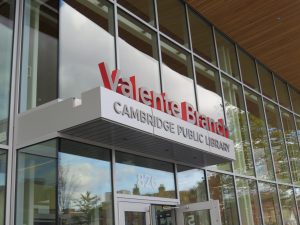
On November 4, 2019, the Cambridge Public Library’s new Valente Branch, a component of the King Open/Cambridge Street Upper Schools and Community Complex, opened as a net zero ready building, which means the infrastructure for net zero is in place. The last component for full net zero operations is the purchase of green electricity produced elsewhere. With 100% of building systems running on electric power, there are no fossil fuels used throughout the complex, adhering to the City of Cambridge’s commitment to make all public buildings net zero by 2040. The complex contains 190 geothermal wells approximately 500 feet down in the earth, and will collect solar energy from 74,070 square feet of on-site photovoltaic array. When the sun is not shining, the rain that falls is harvested for toilet flushing and irrigation. This use of the existing environment has the complex, including the library, on track for a targeted LEED level of platinum.
On October 29, 2019, at the Groundbreaking of the Medford Public Library, Medford’s commitment to net zero public buildings by 2050 was proudly celebrated. Using a unique arrangement of photovoltaic array on the waved roof of the new library, the building is projected to be net zero with no fossil-fuel use upon opening. The project is on target to be Medford’s first public building reaching LEED certification or higher.
Achieving sustainability at the LEED and net zero levels requires forethought and prioritization of those goals throughout the design process. At Library Journal’s Design Institute in Austin, Texas, Gail Vittori, the Co-Director of the Center for Maximum Potential Building Systems, shared the detailed timeline for the Austin Central Library’s platinum-level LEED building. Planning began in 2007, with the team having to anticipate future advances in LEED requirements for a building that would not come to fruition until ten years later. John Daniels, the LEED AP and Interim Facilities Director at the Austin Central Library, emphasized that if sustainability is not a priority, essential elements can fall prey to cost-cutting measures to remain within budget. From selecting a site that allows for production of renewable energy to constructing a building envelope that utilizes principles of passive building design to choosing finishes that are local, recycled, and environmentally-friendly, each step must be approached with sustainability as a driving factor.
For libraries that already stand, a growing body of case studies and best practices for deep energy retrofits has emerged within the last decade. Deep energy retrofits usually involve a whole building approach, but as mechanical systems and building envelopes may have different life cycles, libraries may have to pursue each upgrade piecemeal. Just as with new construction, prioritizing energy efficiency and reduced or eliminated carbon emissions in each decision can forge a path toward a passive building or a net zero building.
The most successful green initiatives are whole-community initiatives, with pledges like Cambridge’s and Medford’s to make all public buildings models of efficiency and sustainability by a targeted year. The support of community members and their local officials, who vote to provide the matching monetary-backing of public library projects, is essential for ensuring buildings that work for the best interests of future generations and the environment. Forward-thinking design and construction is possible with detailed planning and unwavering commitment.
Our commitment to helping libraries achieve sustainability continues with targeted programming this Spring, beginning with a Sustainability Summit at the Shrewsbury Public Library on April 29, 2020, from 10 AM to 1 PM. A link to registration and more information will be provided as the date approaches.