Month: November 2025

  • MBLC Update – November 26, 2025

    Dear Colleagues:

    Today we received more good news about the Institute of Museum and Library Services (IMLS).

    The Rhode Island v. Trump First Circuit argument scheduled for Dec 4 in Boston will not be going forward.  In light of the district court’s granting of summary judgment and a permanent injunction to the states, the federal government filed an assented-to motion to dismiss the appeal as moot, which the court granted yesterday.

    As a refresher, last Friday, November 21, U.S. District Court Chief Judge John J. McConnell ruled in favor of 21 state attorneys general, including Massachusetts, determining that Executive Order 14238, which sought to dismantle IMLS, exceeded presidential authority and violated laws governing agencies established by Congress.

    The court ruling permanently blocks Executive Order 14238 and ensures that IMLS can continue delivering critical support and funding for libraries nationwide and prohibits any further attempts to dismantle the agency.

    If the Trump administration appeals the permanent injunction, we will keep you informed. For now, this is great news for IMLS!

    Happy Thanksgiving!

    Maureen Amyot

  • Service Update – November 26, 2025


    MBLC Monthly Board Meeting on December 3 (Hybrid) 
    Contact: Rachel Masse 

    The regular monthly board meeting of the Massachusetts Board of Library Commissioners is scheduled for 9AM on Wednesday, December 3, 2025, at the MBLC Office, 90 Canal Street, Suite 500, Boston, MA. 


    IMLS Protected by Major Court Ruling as Appeal Moves Forward in Boston

    UPDATE: as of 11:30AM 11/26/2025, the December 4 hearing has been canceled.  

     On Friday, November 21, U.S. District Court Chief Judge for the District of Rhode Island John J. McConnell blocked the effort to eliminate the IMLS in a case filed by attorneys general from 21 states, including Massachusetts. An upcoming First Circuit Court of Appeals hearing is scheduled for Thursday, December 4, 2025, at John Joseph Moakley U.S. Courthouse in the Trump administration’s appeal of the preliminary injunction that was issued in Rhode Island v. Trump. For more on the details on viewing or attending the upcoming hearing and IMLS funding for FY2026, visit the MBLC website. 


    Packed House at Dedication for New Swansea Free Public Library  

    Contact: Celeste Bruno 

    State and local officials joined residents, library trustees, and staff on Saturday, November 8, 2025, to celebrate the grand opening of the new Swansea Free Public Library. The ribbon-cutting ceremony brought together hundreds of people from the community and marked the completion of the long-anticipated project which was supported in part by a $7.7 million grant from the Massachusetts Board of Library Commissioners’ (MBLC) Massachusetts Public Library Construction Program (MPLCP).  For more on Swansea’s new library, visit the MBLC website


    2025 Commissioner Award Winners Honored at State House 

    Contact: June Thammasnong 

    The Massachusetts Board of Library Commissioners (MBLC) celebrated its 135th anniversary at the Massachusetts State House with the 2025 Commissioner Awards Ceremony, honoring individuals and organizations whose leadership and advocacy have strengthened library services across the Commonwealth.  More photos of the event are available at the 135th Anniversary Commissioner Awards MBLC flickr album.  For more on the ceremony, visit the MBLC website.  


    FY26 State Aid Certifications Continue! 

    Contact: Cate Merlin, Jen Inglis 

    Congratulations to the first group of municipalities certified for FY26 State Aid! The list of municipalities and initial awards (as well as past awards) can be found here: https://mblc.state.ma.us/programs-and-support/state-aid-and-aris/awards.php 

    The second group of municipalities to be certified will be brought before the Board of Library Commissioners at their December 3rd meeting, and certifications will continue at the January meeting. We’ll email the State Aid listserv after each meeting with a list of municipalities certified and their initial State Aid grant awards- Directors, be sure you’re signed up here: https://mblc.state.ma.us/sympa/info/stateaid.  

    We’re taking a break from State Aid Office Hours so we can focus on certifying all municipalities as quickly as possible- but don’t hesitate to reach out with any questions about State Aid or your upcoming FY27 budget cycle! 


    Justice Involved Library Services: A Roundtable Discussion (Online) 

    Contact: Ally Dowds 

    Thursday, December 4 at 1PM – Registration & More Information 

    Connect with fellow librarians providing library services to individuals currently and formerly experiencing incarceration in state, county and youth facilities in Massachusetts. Join this conversation to exchange ideas, collaborate on projects, and build a supportive community. Whether you work directly in a carceral facility, have experience collaborating with institutions to provide outreach, or you are a librarian interested in developing an outreach partnership, this meetup group provides a forum to come together for meaningful discussion and resource sharing. 

    Registration is not required. This is an existing group that meets monthly on the first Thursday at 1pm. 


    Web Accessibility Office Hours (Online) 

    Contact: Jaccavrie McNeely, Kate Butler 

    Friday, December 5 at 11AM – More Information & Zoom Link 

    Wednesday, December 17 at 3PM – More Information &  Zoom Link 

    Need help making your web content accessible?  MBLC staff are here to help!  Join our office hours every first Friday at 11AM or third Wednesday at 3PM.  View all upcoming Web Accessibility programming under the Internet, Technology, and Access category on our calendar. 


    Library Advisory Office Hours (Online) 

    Contact: Al Hayden 

    Monday, December 8 at 9AM – More Information & Zoom Link 

    Monday, December 22 at 2PM – More Information & Zoom Link 

    Open to all Directors, Trustees, Library Friends, and Foundation Members. They are designed to be an open-ended, safe space for questions and interaction among participants. Sessions will NOT be recorded, and chats will NOT be saved. Registration is not required; stop by anytime during the hour! 


    NEW BLOG POST! Fortifying Your Library: What about YOUR library? 

    Contact: Al Hayden 

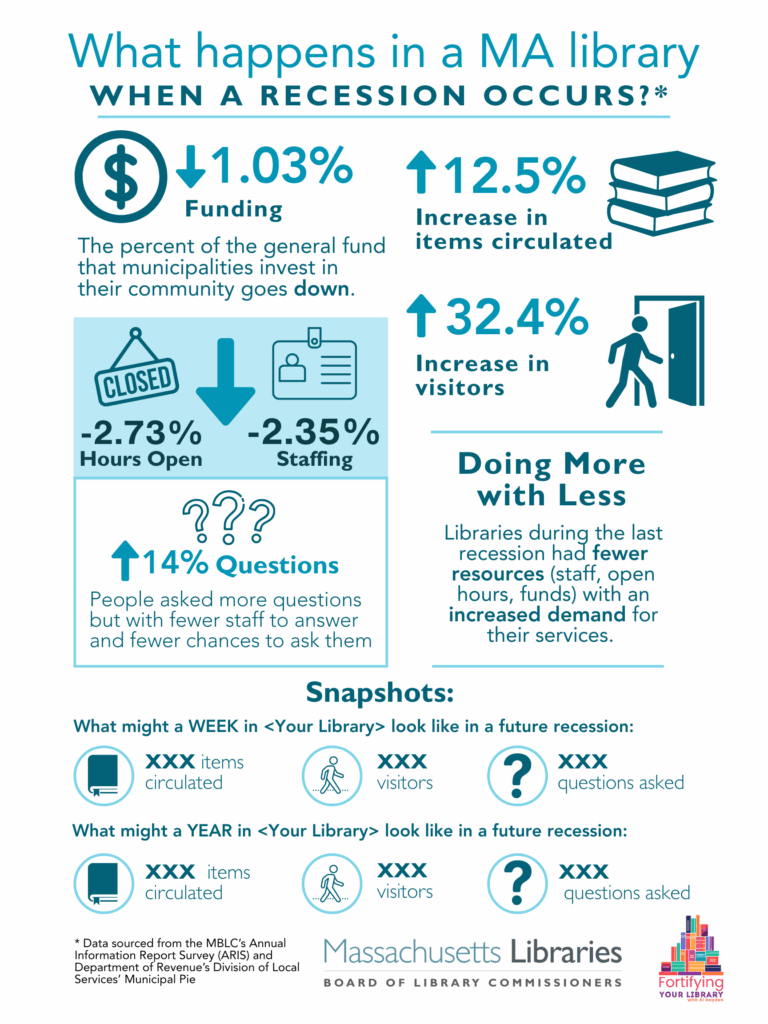
    If you’ve followed me all the way down this experimental rabbit hole, thank you! Here is what we’ve learned about what happens in libraries in an economic downturn: When a recession hits, the need for library services don’t slow down.  They surge.  To help demonstrate how a future economic downturn may affect your library, I have created an editable infographic template on Canva and accompanying Recession Calculator spreadsheetTo learn more about how a recession could affect your library, visit the MBLC blog.  


    Join MBLC’s Free Environmental Monitoring Program by November 30 

    Contact: Jessica Branco Colati 

    The MBLC is offering another round of free environmental monitoring support with Conserv from January-June 2026. Participating sites receive Conserv’s monitoring equipment, a dedicated Conserv Cloud account through June of 2026, training sessions, online learning resources, webinars on collections care, and optional virtual or in-person consultations. To join the program, complete the interest form at https://mblc.libwizard.com/f/em-cohort-d-interest by November 30, 2025. Questions can be directed to MBLC Preservation Specialist Jess Colati at jessica.colati@mass.gov


    Core Connections: Building Community Supports & Allyship at Your Library (Online) 

    Contact: Ally Dowds 

    Building Deaf-Friendly Libraries – January 14, 2026 – Registration & More Information 

    Join us for a new 12-month series that showcases the value of library strategic partnerships and meaningful allyship in our work environments to provide supports to vulnerable and marginalized individuals. Through a mix of informational sessions, workshops and panel discussions, library staff and stakeholders will explore collaborations and best practices that provide practical solutions and resources for trauma-informed, inclusive library environments. Explore new topics each month with statewide partners that address emerging library trends, adaptive and accessible spaces for people living with disabilities, and outreach to isolated community members who may be aging, struggling with mental health or justice impacted. January’s topic is Building Deaf-Friendly Libraries. 


    MBLC Monthly Board Meeting on January 8 (Hybrid) 
    Contact: Rachel Masse 

    The regular monthly board meeting of the Massachusetts Board of Library Commissioners is scheduled for 10AM on Thursday, January 8, 2026, at the MBLC Offices. 

  • MBLC Update – November 24, 2025

    Dear Colleagues:

    The library community across Massachusetts is applauding a major federal court ruling that permanently blocks Executive Order 14238, which sought to dismantle the Institute of Museum and Library Services (IMLS), the nation’s only federal agency dedicated to supporting libraries and museums.

    On November 21, U.S. District Court Chief Judge John J. McConnell ruled in favor of 21 state attorneys general, including Massachusetts, determining that the order exceeded presidential authority and violated laws governing agencies established by Congress. The ruling ensures that IMLS can continue delivering critical support and funding for libraries nationwide and prohibits any further attempts to dismantle the agency.

    The uncertainty of the past few months highlighted how essential IMLS is to equitable library service. Disruptions such as interlibrary loan shutdowns in South Dakota and Florida, cuts to statewide databases here in Massachusetts, and staff layoffs at the Maine State Library are just a few examples of how the absence of IMLS funding impacted the entire nation.

    Upcoming First Circuit Court of Appeals Hearing in Boston 

    Oral arguments have been scheduled at John Joseph Moakley U.S. Courthouse in Boston on Thursday, December 4, 2025, in the Trump administration’s appeal of the preliminary injunction that was issued in Rhode Island v. Trump. The hearing is set to begin at 9:30 a.m. and details can be found on the court’s calendar. Members of the public may listen to the live audio of oral argument or may attend oral arguments in-person; more information on attending is available at the U.S. Court of Appeals for the First Circuit website

    FY2026 Funding
    While the ruling protects IMLS from elimination, FY2026 funding levels are still being finalized. The agency is currently funded at FY2025 levels under a Continuing Resolution through January, and both the House and Senate have restored IMLS funding in their budget revisions. The proposed $291.8 million allocation includes a modest cut overall but a slight increase to the Grants to States program, which supports services here in Massachusetts.

    For more detailed information on the lawsuit and the next steps in supporting IMLS, visit: https://bookriot.com/21-attorney-generals-lawsuit-decision/

    Please continue to reach out with questions or concerns anytime.

    Sincerely,

    Maureen Amyot

    Director, Massachusetts Board of Library Commissioners

  • What about YOUR library?

    What about YOUR library?

    If you’ve followed me all the way down this experimental rabbit hole, thank you! I hope my calculations provided some data you’ll find helpful, or at least interesting. If you were wishing there may be some sort of summary, so you don’t have to wade through 6 posts to get the particular statistics you found most useful, I’m here to help with that as well. Here is what we’ve learned about what happens in libraries in an economic downturn:  

    Nationally:

    In his study “Impact of a Great Recession on Library Use: Does a Negative Economy Impact Library Use?,” Michael Mabe looked at what happened in libraries looking at usage data from before the Great Recession and during the Great Recession. He found that not only did no library in his sample show a reduction in use, but he found statistically significant evidence that:  

    • Circulation increased by an average of 13.3% 
    • Visitors increased by an average of 26.8% 
    • Usage was not related the funding that a library received  

    Massachusetts: Libraries Did More…

    In looking at the same years and starting with the same metrics, I found that Massachusetts libraries’ usage was affected during the Great Recession in the following ways: 

    • Circulation increased on average by 12.5% 
    • Visitors increased on average by 32.4% 
    • Circulation for children’s items increased on average by 13.2% 
    • Reference transactions increased on average by 14.0% 
    • Summer reading participation increased on average by 35.6% 
    • Bookmobiles and branches’ (outlet) circulation increased on average by 27.4% 
    • Outlets’ visitors increased on average by 52.3% 
    • Outlets’ reference transactions increased on average by 51.2% 

    …With Less

    I also found that during the Great Recession, Massachusetts libraries had: 

    • The percent of their general fund that municipalities invested in libraries decreased on average by -1.03% 
    • Staffing in libraires decreased on average by -2.35% 
    • The number of hours libraries were open decreased on average by -2.73% 
    • The number of hours outlets were open decreased on average by -7.10% 

    I’ve also outlined many of the findings I’ve described in this series in an infographic which you can download and use here:  

    Your Library’s Story, In Context

    I’ve used averages for all MA libraries for 2 reasons:  

    1) to make the data I used as comparable as possible to the original study and 

    2) because calculating the numbers for all 351 municipalities is not a project that normal working hours would allow me to take on. But while the numbers for libraries across the state tell a powerful story, when it comes to how you tell your library’s story, it may also be helpful to demonstrate how a future economic downturn may affect your library, specifically in the context of these averages.  

    To that end, I have also created an editable template of the above infographic and an accompanying spreadsheet that you can use to learn and share more about what a recession may look like for your library. Feel free to use this information and infographic to highlight the most impactful statistics that demonstrate what your library will experience should the statewide percentages hold true in a future economic downturn. Add your library’s logo and branded colors. Then, use it to tell anyone who may advocate for, have control over, and want to learn more about YOUR library and its budget.  

    Please keep in mind a few things to help ensure that whatever you might put out does not get misconstrued or perceived as disingenuous:  

    • the percentages that I use to calculate all of the hypothetical extrapolations reflect how libraries changed during the Great Recession 
    • none of this is designed to predict the future, only to model a potential scenario should we experience an economic downturn; the exact effects are and will remain unknown until we’re able to look back and reflect on what happened 
    • models and extrapolations are used all the time, in many different fields, as a framework for understanding how a pattern may emerge in potential circumstances; they are not irrefutable in any field, but they can be a powerful way of explaining the potential for a need before that need actually arises 

    I have before stressed that librarians are professionals and, by extension, the field of library studies is a solid, professional field. We can (and should) use the tools other professionals employ to make their case, to make the case for our libraries.  

    I hope you find this information and these tools helpful to you in some way. I’ll be poking around some more rabbit holes in the search for more information, policy best practices, and tools that hopefully, you will also consider helpful additional ways to fortify your library.  

    Al Hayden, MBLC Library Advisory Specialist

  • Senator Jake Oliveira’s Speech at November 13, 2025 Senate Hearing on An Act Regarding Free Expression

    (Senator Oliveira’s full speech is available to view at: https://drive.google.com/file/d/1P0oMZ4eB8qz6iiYZyq5_Ac7sA2FpiPRG/view?usp=sharing)

    I also want to thank the Senator from the Cape and the Islands, not only for filing this vital legislation, but for his unwavering commitment to protecting the freedoms that define us: the freedom to read, the freedom to learn, and the freedom for everyone to see themselves reflected in the stories that shape our communities.

    At its core, this bill is about trust. Trust in our librarians. Trust in our educators. Trust in the belief that every person in the Commonwealth deserves the opportunity to see not only themselves, but their families, their identities, and their experiences reflected in the books and ideas available in our public and school libraries.

    Our libraries are more than shelves and stacks. They are mirrors and windows. Mirrors that not only help us see ourselves, but also windows that help us see and understand others.

    When we trust our librarians to do their jobs, jobs for which they have been extensively educated, we protect that. We ensure that every voice, every story, and every reader has a place in Massachusetts. That is the heart of the legislation before us, and it’s why I am proud to stand in support of it.

    Madam President, when I ran for the school committee in my hometown 16 years ago, I never imagined that I’d be thrust into the center of a fight over libraries, librarians, and freedom of expression. But in my own hometown of Ludlow, that’s exactly what happened.

    Before being elected to this legislature, the Ludlow School Committee began hearing from a small, but loud minority that would have banned certain books from our school libraries. These loud voices, driven by a hate organization based nearly 100 miles outside of my community claimed to “protect children.” But the truth is, it wasn’t about protection. It was about control. It was about erasing stories that made some people uncomfortable.

    And suddenly, this wasn’t a national debate I was watching unfold on the news. It wasn’t something happening in another state. It was happening right where I grew up, in the schools I attended, in a community I deeply love.

    That’s when I realized this fight isn’t in some far-off place. It’s right here in our neighborhoods, in our classrooms, in our libraries, in our communities.

    Communities across Massachusetts, communities with LGBTQIA+ individuals, people of color, and families from every background, are facing the same struggle.

    These are our neighbors, our classmates, our coworkers. They deserve to have their stories told. They deserve to see themselves reflected in the works available at our public and school libraries.

    Because when we erase stories, we erase people.

    Today, we have an opportunity to say, “Not in Massachusetts.”

    And to make sure that decisions about library materials are made by trained, professional librarians, not by politicians or activists looking to score points in a culture war.

    That’s what this bill is about. It’s about fairness, expertise, and inclusivity. It’s about trusting the professionals who dedicate their lives to connecting people with ideas and recognizing that knowledge should be guided by professional standards, not partisan agendas.

    And it’s about something even deeper: our belief in free expression and in the idea that every voice, every story, and every reader deserves a place in Massachusetts.

    Across the country, we’ve seen record numbers of book challenges—over 4,000 titles targeted for removal or restriction last year, according to the American Library Association. Here in Massachusetts, there were 37 challenges in 2023 alone, affecting 63 titles. That’s not some far off place. That’s right here at home.

    And let’s be clear, these challenges are not random. Most target books are written by or about people of color and LGBTQ+ individuals. These efforts are deliberate. They are about making certain people and experiences invisible.

    When we remove those stories, we don’t just erase books; we erase people. We take away the chance for young readers to discover themselves and for communities to understand one another. We lose empathy. And without empathy, democracy falters.

    This bill draws a line in defense of inclusion, professionalism, and trust. It ensures that challenges to library materials are handled transparently and professionally. It guarantees that materials remain accessible during review and that librarians and educators are protected when they uphold the values of intellectual freedom.

    It modernizes our public library law, requiring written policies grounded in the Library Bill of Rights, because access to information should never depend on the political winds of the moment.

    Madam President, history reminds us that censorship rarely begins with dramatic gestures. It begins quietly, with one book removed, one voice dismissed, one story silenced. But here in Massachusetts, we can choose a different path today.

    We can choose trust. We can choose access. We can choose to see one another.

    So today, as someone who was thrust into this fight not by choice but by necessity, I stand here proud to say: Massachusetts will continue to lead.

    Not by banning books, but by building bridges. Not by silencing voices, but by amplifying them. Not by giving in to fear, but by standing firm in freedom.

    Let’s pass this bill and make clear that in the Commonwealth of Massachusetts, every reader matters, every story belongs, and every community is seen.

    Thank you, Madam President.
  • RE: FY 2027 State Budget for the Commonwealth’s Libraries through the Massachusetts Board of Library Commissioners

    October 30, 2025

    Dear Governor Healey:

    The Massachusetts Board of Library Commissioners (MBLC) would like to thank you, the Lieutenant Governor, and your administration for your unwavering support of libraries. Being a part of our conferences, construction events, filing a federal lawsuit to prevent the dismantling of the Institute of Museum and Library Services, and attending one of our meetings as we grapple with book bans mean so much to the entire library community.

    In the coming months, we know that your administration will face difficult choices as you formulate the FY2027 state budget. In light of the ongoing issues and uncertainty brought on by the federal cuts, policies, and executive orders, we want to provide you with a snapshot of how the Commonwealth’s libraries are doing, the challenges they are facing, and the ways that librarians are rising to meet the moment.

    For many, life today means living in fear simply because of who they are. Rising prices make it harder for families, older adults, and young people just starting out to make ends meet. Massive layoffs at the federal level, and the destabilization of some of the Commonwealth’s most important sectors makes one wonder if the next job to be cut will be theirs. People who live in the margins become even more vulnerable.

    These are the people we serve every day, and this is why libraries are needed now more than ever. Immigrants find support and citizen classes. Preschoolers and adults learn to read. Jobseekers sharpen skills. Teens find research help and buckle down in quiet study spaces. People with disabilities find materials that provide access. Unhoused people find a safe place to be for a while. People connect and no longer see each other as “other.”

    Perhaps most importantly, everyone who walks into the library finds materials and events that represent diverse perspectives. Books that are banned in many other states are on the shelves in Massachusetts libraries because librarians and library staff continually defend everyone’s right to read.

    It is in times of hardship and uncertainty that even more people turn to libraries. It’s what we’re already experiencing with an all-time high of more than 65 million items checked out last year. People of all ages, abilities, and backgrounds are going to library events — attendance rates jumped by 35%. The usage of eBooks, which can cost up to 6 times the consumer price for libraries to purchase, skyrocketed by more than 300% in the last decade. Community use of library meeting rooms increased by 30% over the same time period.

    And that’s just “traditional” library services. Libraries connect people with essential services, as safety nets are eroding. For example, some of these critical programs are:

    • Public libraries in Cambridge, Pittsfield, Somerville, Worcester and Boston have hired full-time library social workers to support many needs including benefits eligibility and applications, food resources, housing, and employment; and resources for immigrants, refugees, LGBTQ+, and justice-impacted folks.
    • Plymouth Public Library’s Recovery Corner provides people with low-barrier access to information on substance use disorder, treatment options and centers, as well as harm reduction centers and supplies.
    • The Montague Public Library developed teen-centric programming and collections that address social isolation and mental health among tweens and teens. This project is in partnership with The Brick House, a nonprofit youth resource center.
    • The Wayland Public Library’s home delivery service enables access to library resources for people unable to visit the library on their own, reducing feelings of isolation and keeping folks connected to their communities and interests.

    Libraries across the state are now loaning integrated assistive and adaptive technology to patrons with disabilities. These range from practical tools, such as wheelchairs and eyeglasses, to high-tech tools like screen readers and cutting-edge scene interpreters driven by artificial intelligence. Partnerships between the Perkins Library, the ARC of Massachusetts, the Massachusetts Commission for the Deaf and Hard of Hearing, and the library community allow access to expert guidance and referrals.

    Libraries across the Commonwealth are not just providing traditional library services. Every day, libraries are stepping in to support people in ways that other organizations are not, or cannot.

    Just as more and more people turn to libraries, funding for libraries is being cut. Earlier this year due to interruptions in federal funding, the MBLC was forced to make cuts to statewide services. This spring, several libraries including Stoneham, Lynnfield, and Orange faced drastic local cuts or closure.

    Last year we tracked 22 municipalities that had to resort to budget overrides to fund library operations. For this fiscal year, we’ve already heard from many libraries that are facing cuts from their municipalities.

    It is why even in this most difficult economic year, the Massachusetts Board of Library Commissioners respectfully requests local aid to libraries through the State Aid to Public Libraries Program line 7000-9501 be prioritized and increased by 5% to $21 million from FY26’s $20 million. This is critical unrestricted direct local aid that libraries can use to maintain their services. It has a massive impact across the Commonwealth with 347 out of 351 municipalities certified in the program and receiving this funding. For libraries and the millions of people who depend on them, it’s a lifeline.

    Thank you again for your tremendous support and for your consideration. In 2024, you said the following at our conference: “Libraries are many things to many people. The one thing they are to all people, and every community is: indispensable. No other institution. No other space. No other agency of government or private-sector enterprise can do what libraries do – or do what librarians do.” Those words inspired us then and continue to do so today.

    Sincerely,

    Vicky Biancolo, Chair

    Timothy Cherubini, Vice-Chair

    Joyce Linehan, Secretary

    Katherine Chang, MBLC Commissioner

    George Comeau, MBLC Commissioner

    Deborah Conrad. MBLC Commissioner

    Kemarah Sika, MBLC Commissioner

    Jessica Vilas Novas, MBLC Commissioner

    Karen Traub, MBLC Commissioner