On a recent Wednesday at the public library in Arlington, people diligently return their books, CDs and DVDs on time. Then, there’s Joanne Tuller. She is a delinquent book borrower.
On a recent Wednesday at the public library in Arlington, people diligently return their books, CDs and DVDs on time. Then, there’s Joanne Tuller. She is a delinquent book borrower.
By Evan Knight, Preservation Specialist at the MBLC
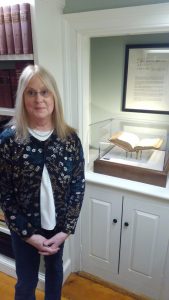
For ALA’s Preservation Week 2019, we are rolling-out a series called “People of Preservation,” highlighting the people taking care of interesting library collections across the Commonwealth of Massachusetts.
The biggest driver of successful preservation and curation is having dedicated and knowledgeable staffs. This series is going to show why, while celebrating their successes!
I’m going to start off by highlighting some recent work by Lucy Loomis, Director of the Sturgis Library in Barnstable.
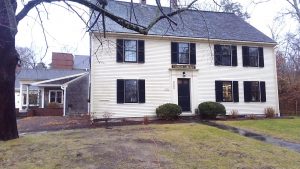
Thanks for all your excellent work, Lucy!
By Lyndsay Forbes, Project Manager and Grant Specialist at the MBLC
While we’re always trying to entice people to come into the library, more and more libraries are recognizing and prioritizing getting out of the physical building and into the community. Outreach is such a critical part of what we librarians do, and it is often the best way to reach those who need our services the most. One way some libraries are reaching out to their communities is through their bookmobile.
Bookmobiles have existed in the U.S. since the turn of the century, though the original ones were horse drawn carriages. The first motorized bookmobiles launched in 1912. While they started as a way to get books to rural and far flung areas, they have adapted over the years and can be found in all types of communities engaging in a variety of services.
Over the years, the popularity of bookmobiles has risen and fallen. There was a decline during both World Wars and the Great Depression. The 1950s and 1960s saw a huge growth, some of which is likely due to the Library Services Act of 1956 as well as additional legislation. While their popularity has fluctuated over the years, you shouldn’t think of them as nostalgic relics from years ago. Bookmobiles are still a part of modern library service in many communities. In fact, there are currently six bookmobiles operating in five public libraries in Massachusetts – Beverly, Chicopee, Natick, New Bedford, and Worcester (which has two).
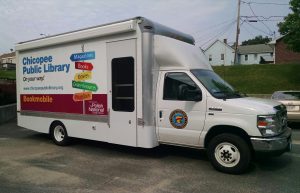
In Chicopee, when you can’t get to the library, there’s a way for it to come to you! Since June 2015, the Chicopee Public Library’s Bookmobile has been a significant part of library outreach. The schedule rotates every few months. Right now, the Bookmobile is using a two week rotation, where they make fifteen stops at eleven different sites. Locations include housing complexes, the Boys and Girls Club, and the Senior Center. Warmer months see the addition of parks and the farmers market among the stops.
Chicopee’s Bookmobile truly is a library on wheels, offering the typical library services you’d expect in a brick and mortar building. On the Bookmobile, you can check out materials, request items for pick up, access online resources, use a WiFi hot spot, register for a library card, and get on the internet via iPads.
If you’re a librarian thinking about getting your own bookmobile, you should know that it can be a large investment in time and money. So, while it’s not something to enter into lightly, many libraries do find it is well worth the effort. And if you’re looking to up your outreach game, it might just be the answer you’re looking for!
By Rob Favini, Head of Library Advisory and Development at the MBLC
The Open Meeting Law generates a lot of questions from trustees across the state. The most frequently asked is, “does this law apply to me?” The short answer is, yes! Public libraries in Massachusetts must adhere to open meeting laws. For corporation or association libraries that receiving ANY amount of municipal funding, following open meeting law is a basic best practice.
Below are links to resources available from Massachusetts Attorney General’s office. We recommend that all trustees review these materials to learn how the law applies to posting meetings, taking meeting minutes, executive sessions, and the use of email and social media.
Open Meeting Law
Public bodies, which generally include public library trustee boards, are required to comply with the Open Meeting Law (MGL ch. 30A, sec. 18-25), as enforced by the state Attorney General’s office. As noted in the AG’s Open Meeting Law Guide, “The purpose of the Open Meeting Law is to ensure transparency in the deliberations on which public policy is based. Because the democratic process depends on the public having knowledge about the considerations underlying governmental action, the Open Meeting Law requires, with some exceptions, that meetings of public bodies be open to the public.”
All library trustees should be familiar with the Open Meeting Law, which mandates meeting notices be posted prior to meetings of public boards, requires records or “minutes” of meetings to be kept, and delineates certain instances in which portions of meetings may be closed to the public. The Attorney General’s office has some helpful resources on their website, including the extremely useful Open Meeting Law Guide. Questions concerning the Open Meeting Law should be directed to the local Town Clerk or the Attorney General’s Division of Open Government (http://www.mass.gov/ago/government-resources/open-meeting-law).
Certain library boards, such as boards of some association libraries that are not municipal departments, may not be considered public bodies under the Open Meeting Law. If such a board is uncertain of whether it must comply with Open Meeting Law, the board should contact the Attorney General’s office directly for a determination. Some association/corporation libraries may be required to follow Open Meeting Law under agreement with the municipality that they serve. It is strongly recommended that all library boards follow the tenets of the Open Meeting Law, even if they are not required to by law. A board that practices openness and transparency will be better able to maintain a good relationship with the municipality and seek support from its community
Information regarding Open Meeting Law can be found on page 41 of the Massachusetts Public Library Trustee Handbook.
Have a question relating to your board? Contact Maura Deedy (maura.deedy@mass.gov) or Rob Favini (robert.favini@state.ma.us)
Please join us at the MBLC’s Trustee Institute, April 27th! For information and registration: https://mblc.libcal.com/event/5158107?hs=a
A new $33 million Tufts Library will provide patrons with dozens of computers, reliable wireless internet capabilities, additional book volumes, CDs and DVDs when it is completed in 15 months.
“We are going from a tight children’s room to one that is two-and-a-half times the size,” said Robert MacLean, Weymouth Public Libraries director during a groundbreaking ceremony March 27. “It will include a story time and craft rooms, study rooms, and a nursery room. There is so much more to come.”
With shovels of dirt, the groundbreaking ceremony between the Erving Elementary School and Senior Center marked the beginning of construction for a $5.5 million public library project on Friday.
It’s hard to imagine that early community leaders — busy compiling, say, the Gloucester Town and Selectman Records starting in 1642 — could have imagined residents accessing those records from a lit screen in their homes nearly 400 years later.