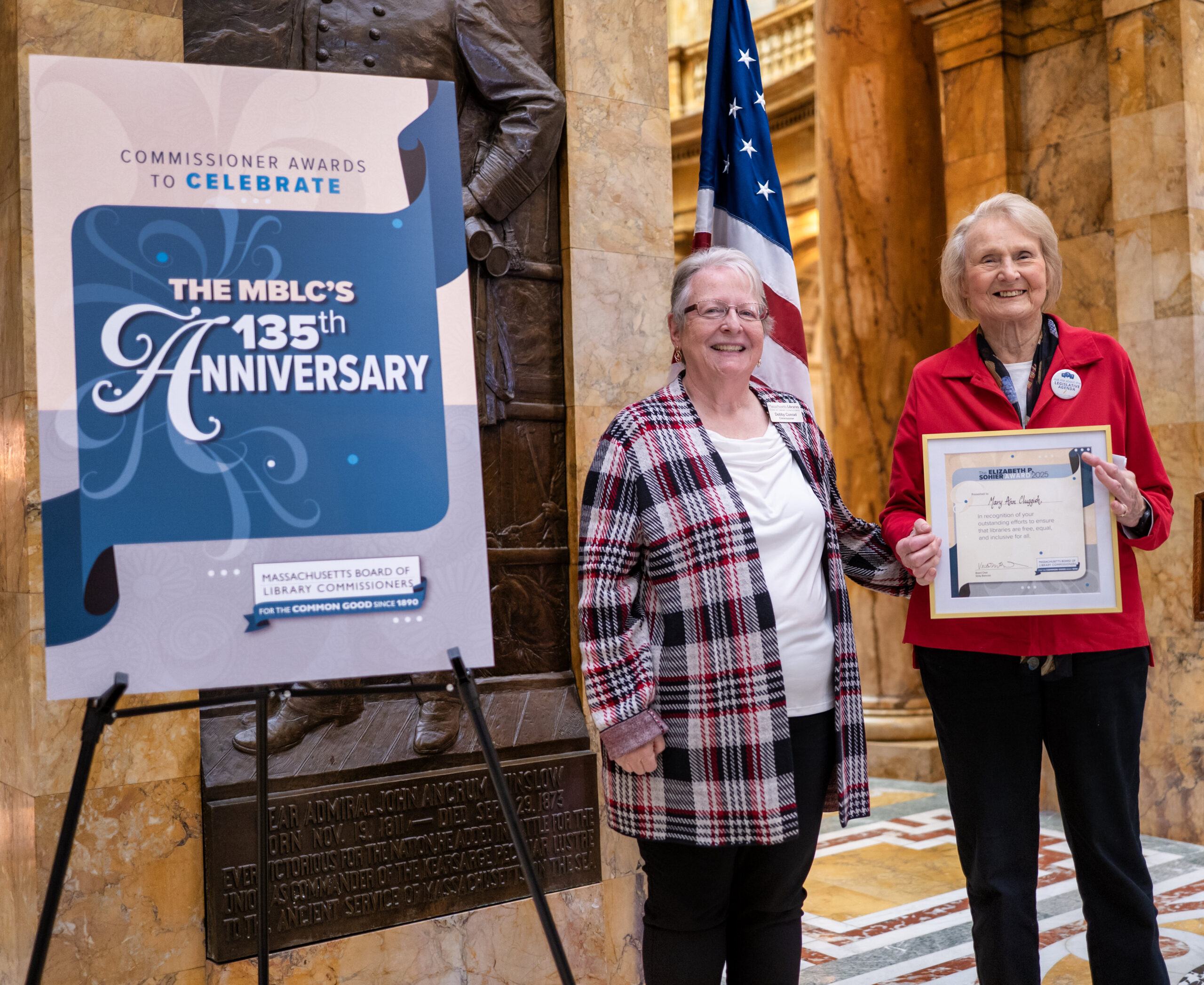
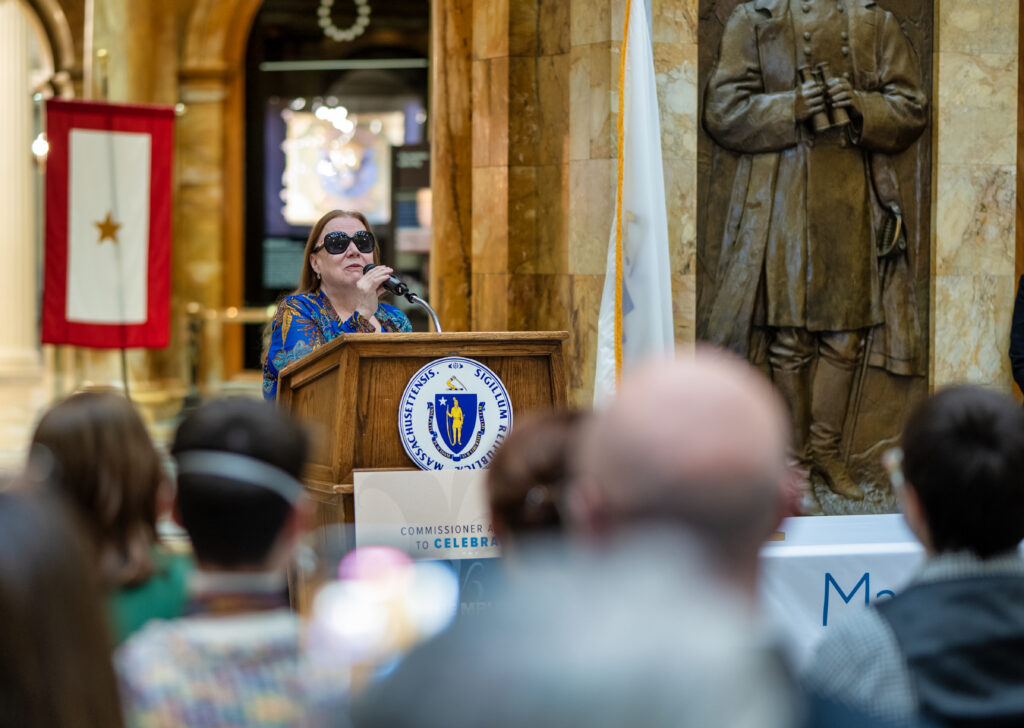
Image: Former MBLC Chair Mary Ann Cluggish (right) accepting the Elizabeth Putnam Sohier Commissioner Award at the MA State House next to MBLC Commissioner Debby Conrad on November 6, 2025.
Elizabeth Putnam Sohier was the driving force behind the Free Public Library Commission, established in 1890, and now known as the Massachusetts Board of Library Commissioners (MBLC). Sohier served as a library Commissioner from the agency’s inception in 1890 until her passing in 1926. She was deeply committed to expanding access to free public libraries, particularly in small towns and rural communities, and worked tirelessly to ensure that state aid for libraries reached underserved areas.
The Elizabeth Putnam Sohier Commissioner Award honors a former Commissioner from the MBLC for their outstanding efforts to ensure that all residents have equal and free access to the resources available through Massachusetts public libraries. For her extraordinary dedication to libraries, the MBLC was pleased to award the 2025 Elizabeth Putnam Sohier Commissioner award to Mary Ann Cluggish. Mary Ann Cluggish’s leadership and advocacy led to increased state aid for libraries and bond funding for the Massachusetts Public Library Construction Program.
For over forty years, Mary Ann has devoted her time and advocacy to libraries as trustee of the Wellesley Free Library and Commissioner for the MBLC under the appointment of three governors: Deval Patrick, Charlie Baker and Maura Healey. Never afraid to speak up on behalf of libraries, Mary Ann was relentless in her efforts to reach out to legislators to secure funding for Massachusetts libraries and has said “In this digital age, libraries are longer transactional. They are transformational. When you walk into a library your world gets bigger.” Because of Mary Ann’s efforts and commitment to libraries, she has certainly made the world of libraries more inclusive, free and equal.
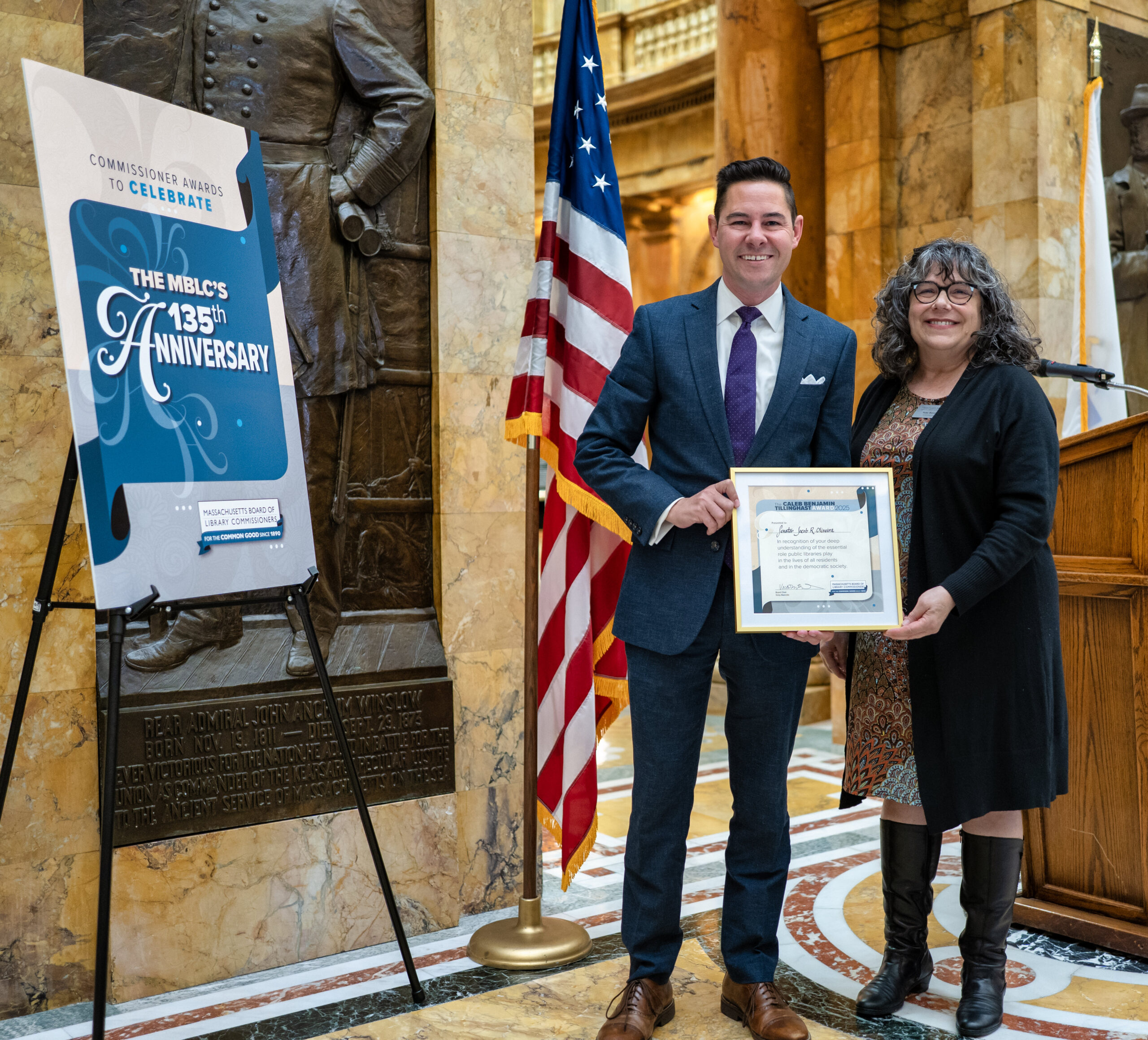
Image: Senator Jake Oliveira (left) accepting the Caleb Benjamin Tillinghast Commissioner Award at the MA State House next to MBLC Chair Vicky Biancolo on November 6, 2025.
Caleb Jacob Tillinghast was a librarian, journalist, educator and public servant whose long career left a lasting mark on the Massachusetts State House Library. He was one of the five founding Commissioners of the Free Public Library Commission of Massachusetts, established in 1890, known today as the Massachusetts Board of Library Commissioners (MBLC). Tillinghast worked as the Massachusetts State Librarian and served as a library commissioner advancing the idea of libraries as essential civic institutions, promoting education, democratic participation, and equal access to knowledge.
The Caleb Benjamin Tillinghast Award honors a federal or state legislator whose work is guided by a deep understanding of the essential role public libraries play in the lives of residents and in a democratic society. The MBLC was pleased to present Senator Jake Oliveira with the 2025 Caleb Benjamin Tillinghast Commissioner Award at the MBLC’s 135th Anniversary held at the Massachusetts State House on November 6, 2025. His inaugural speech on the senate floor ignited the library community when he spoke against the increasing book challenges and bans ramping up across the nation and in the Commonwealth.
Senator Oliveira has championed the right to read legislation to protect libraries and library staff, worked to increase funding to regional libraries and supported library construction and local aid. Spearheaded by Senator Julian Cyr, Oliveira helped pass legislation in the Massachusetts Senate (Bill S. 2726) to protect intellectual freedom in schools and public libraries reinforcing access to diverse education resources. Senator Oliveira has centered libraries in his work as educator, municipal leader and now Senator, carrying on Tillinghast’s legacy and paving his own path to protect libraries as institutions of free thinking and a place where everyone belongs.
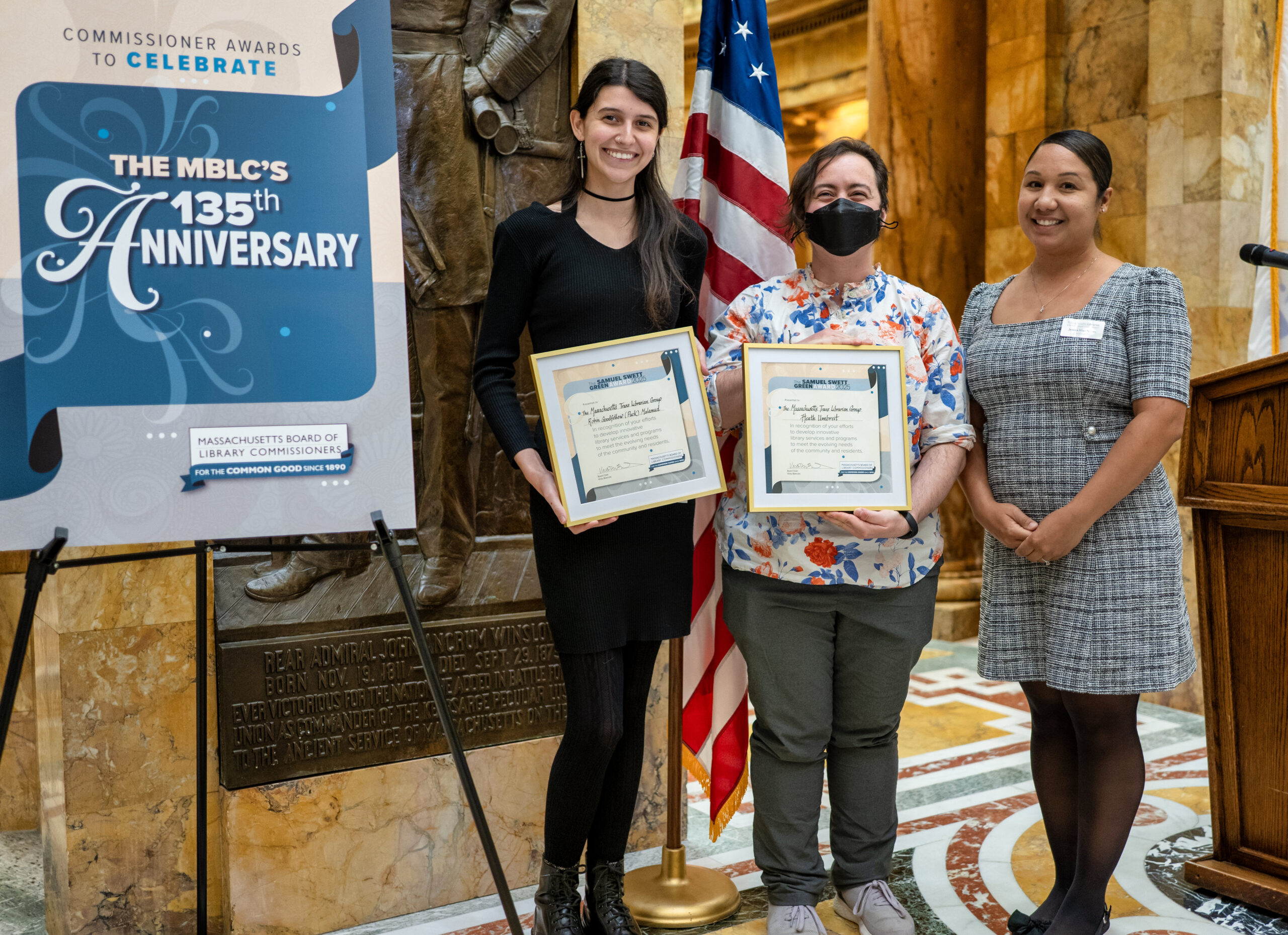
Image: Ren O’Brien (left), Robin Goodfellow “Puck” Malamud (middle) accepting the Samuel Swett Green Commissioner Award on behalf of The Massachusetts Trans Librarian Group at the MA State House next to MBLC Commissioner Jessica Vilas Novas on November 6, 2025.
Samuel Swett Green was a librarian that championed library services for all. He was often referred to as the “Father of Modern Research Librarians” and believed any one and everyone should be able to ask a librarian for assistance with information. Green was a founding member of the Free Public Library Commission of Massachusetts, established in 1890, now known as the Massachusetts Board of Library Commissioners (MBLC). Green was also a member of the group that helped found the American Library Association and served as the organization’s president, championing the idea that libraries should be free, inclusive and welcoming to all members of society.
The Samuel Swett Green Award honors a Massachusetts librarian who develops innovative library services and programs to meet the evolving needs of the community and Commonwealth residents. At the MBLC’s 135th Anniversary, the Samuel Swett Green Award was presented to The Massachusetts Trans Librarians Group, with acceptance remarks made by Ren O’Brien and Robin Goodfellow “Puck” Malamud. Since its formation, the Massachusetts Trans Librarians group have volunteered their time, emotional energy and professional expertise to provide resources and guidance to library colleagues throughout the Commonwealth.
During this time of widespread book banning, threats to intellectual freedom and censorship of library materials, programs and events, the Massachusetts Trans Librarians group have spoken against discrimination, worked collaboratively on how to foster healthy, safe environments and how to improve Trans inclusion and advocacy in libraries. The Massachusetts Trans Librarians group created the Library Safety Volunteers to train fellow library workers in community safety and de-escalation to ensure LGBTQIA+ library events and programs are protected. They have worked with The Massachusetts Commission on LGBTQ+ Youth and Library of Congress’ Gender and Sexuality Funnel Project. Their work is brave, and not only serves the LGBTQIA+ community, but celebrates inclusivity for all so that libraries remain a place where everyone belongs.
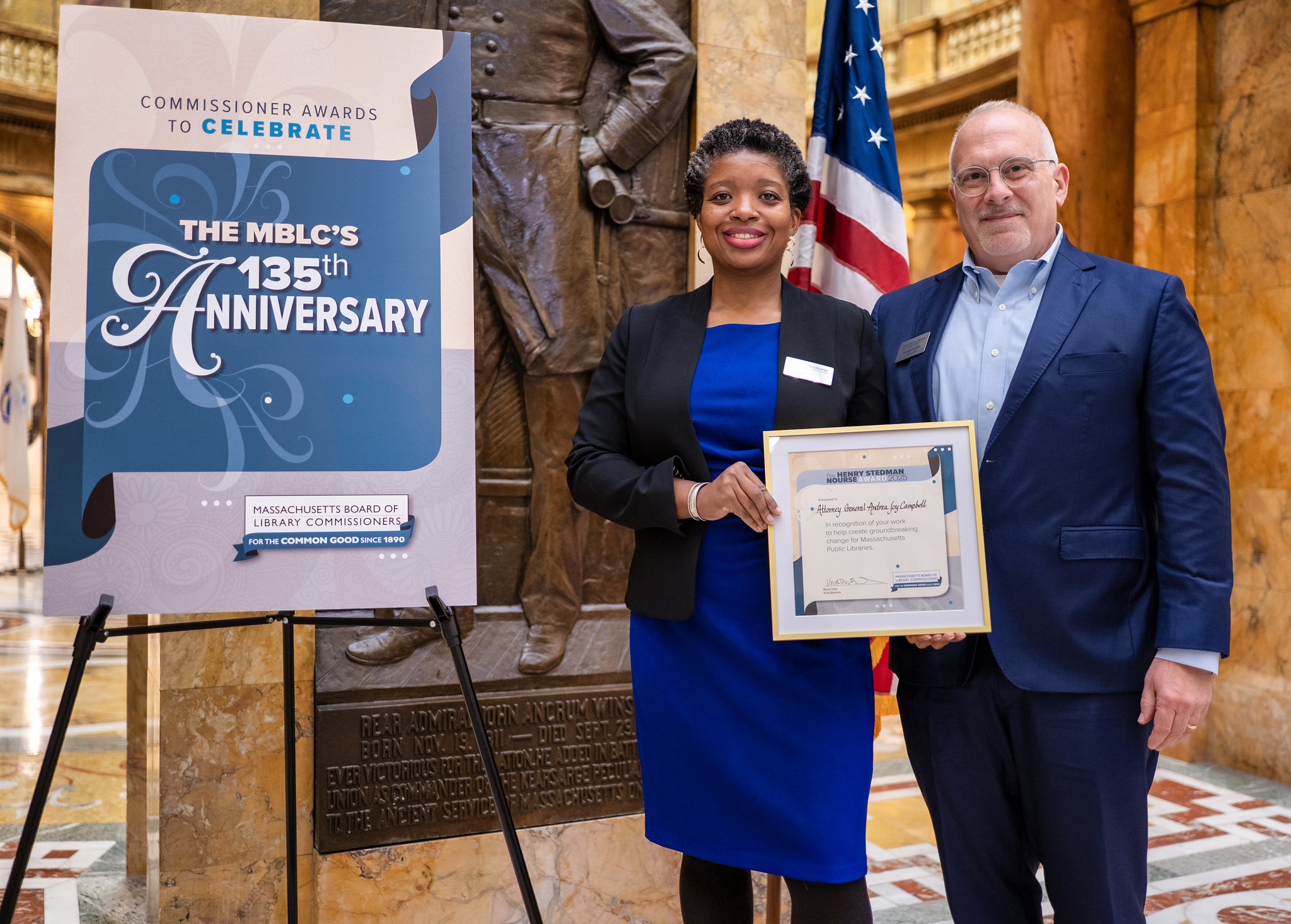
(Image: MBLC Commissioner Kemarah Sika (left) accepting the Henry Nourse Stedman Commissioner Award on behalf of Attorney General Andrea Joy Campbell at the MA State House next to MBLC Vice Chair Tim Cherubini on November 6, 2025.)
Henry Stedman Nourse was a Civil War Veteran, Professor of Ancient Languages at Phillips Exeter Academy, State Legislator for the town of Lancaster and one of the five founding members of the Free Public Library Commission of Massachusetts established in 1890, now known as the Massachusetts Board of Library Commissioners (MBLC). Nourse was instrumental in establishing libraries across the Commonwealth and advocated for public libraries to provide free access to books and learning for everyone, regardless of socioeconomic background or geography. This was a shift from elitist norms of the time, as he supported literacy and education as universal rights, laying the groundwork for intellectual freedom.
The Henry Stedman Nourse Commissioner Award honors a Massachusetts public official whose work has helped to create groundbreaking change for Commonwealth public libraries. On November 6, 2025, Massachusetts Attorney General Andrea Joy Campbell was awarded the 2025 Henry Stedman Nourse Commissioner Award as part of the MBLC’s 135th Anniversary Celebration. Her dedication to protecting our libraries, intellectual freedom and right to read against censorship and book banning nationwide and in Massachusetts ensures that libraries are key to a free democracy and here to stay open as doors of opportunity open to everyone.
When federal library funding was under threat as a result of the Trump administration’s Executive Order 14238, Andrea Joy Campbell’s office took action. Working with attorney generals from 21 other states, her office filed a lawsuit and requested a preliminary injunction to stop the dismantling of the Institute of Museum and Library Services (IMLS), the only federal agency dedicated to funding museums and libraries in the United States. There’s no doubt her efforts contributed to IMLS funding being reinstated in December of 2025, protecting libraries in Massachusetts and across the nation, ensuring a better future with strong and secure library services for us all.
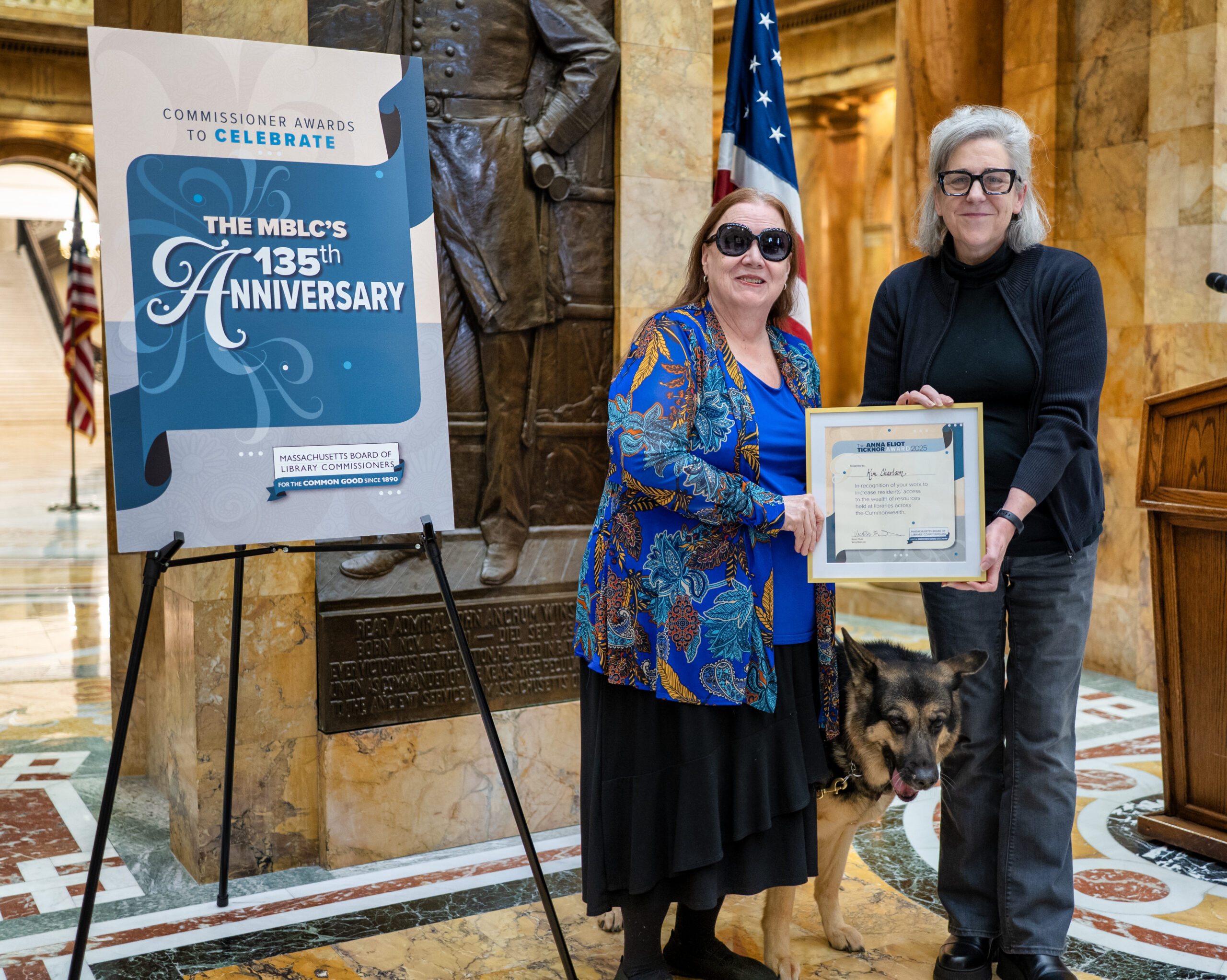
(Image: Kim Charlson (left) accepting the Anna Eliot Ticknor Commissioner Award at the MA State House with her guide dog Idabelle next to MBLC Commissioner Joyce Linehan on November 6, 2025.)
At the MBLC’s Commissioner Awards ceremony, Kim Charlson Executive Director of the Perkins Braille & Talking Book Library was awarded the Anna Eliot Ticknor award which recognizes a Massachusetts librarian whose work has increased residents’ access to the wealth of resources held at libraries across the Commonwealth.
Let’s take a look at Kim’s impressive career that spans over two decades and impacted countless individuals.This year alone Perkins Library will circulate more than 900,000 items to 20,000 patrons with print disabilities.
Kim has been on the forefront of new technology, piloting eBooks, adaptive devices such as Braille eReaders, tactile maps, 3D printers, and online services so that people with disabilities can participate equally in the digital revolution.
Her influence extends to policies and initiatives that have strengthened accessible library services across the Commonwealth. Kim’s wise guidance has equipped libraries of all sizes to welcome residents who might otherwise be left out. She serves on the Massachusetts Department of Elementary and Secondary Education’s Braille Literacy Council, advising on how students across the state can access the materials they need to learn.
~ Ally Dowds, MBLC Consultant to Special Populations
This January, the MBLC is launching a 12-month series, Core Connections, to showcase how libraries are uniquely positioned to create consistent opportunities and partnerships to uplift both our patrons and our staff. The series is a mix of informational sessions, workshops and panel discussions focused on practical tools and resources to build community supports and strengthen allyship of vulnerable and marginalized individuals.
Join us each month to explore new topics with statewide partners and library peers that address emerging library trends, adaptive and accessible spaces for people living with disabilities, and outreach to isolated community members who may be aging, struggling with mental health or justice impacted. Leave with a sense of learning, understanding and deeper support for what it means to break down barriers and foster a culture of care.
Core Connections Roadmap
Building connections isn’t just one single step. It’s ongoing work and immersion. Monthly topics are still developing, may evolve or shift, but the roadmap ahead will hopefully guide and pique your interests to join the conversation.
For library managers, directors and trustees. This session offers a forum to explore what meaningful allyship looks like for LGBTQ+ library staff, how library spaces are an essential part of allyship, and a general overview on what can be done to make your workplaces safer and more LGBTQIA+ affirming. Facilitated by the Massachusetts Commission for LGBTQIA Youth
Take a collective breath with Somerville Public Library’s very own social worker, Jake Savage, and familiarize yourself with trauma and the concept of trauma-informed engagement to develop strategies for working with library patrons.
May: Libraries as Health Equity Hubs
A panel featuring perspectives from staff at the Massachusetts Department of Mental Health encouraging conversations on mental health in the workplace and among library service populations.
Hear from library colleagues in Massachusetts who have participated in ALA’s Law for Librarians and are part of a national cadre of trainers empowered to deflect censorship challenges and other legal hurdles impacting libraries.
August: Finding Grants and Funding
As this series builds partnerships and germinates ideas, the next step may be the need for critical funding. Join the MBLC staff and industry colleagues to discuss pathways for funding of new and evolving projects.
September: Allyship in Leadership: Supporting BIPOC Library Staff
For library managers, directors and trustees. A conversation around guidance and dialogue to learn actionable strategies for fostering inclusive leadership and uplifting the experiences of BIPOC staff in library workplaces.
October: Libraries Beyond Accessibility: Serving Patrons with Print and Other Disabilities
Many libraries throughout the Commonwealth are designated access centers and offer special assistive aids and technology. Learn how your library can take this conversation beyond technology and tools for comprehensive, universal engagement. Facilitated by Perkins Library.
November: Allyship in Leadership: Supporting Staff with Disabilities
For library managers, directors and trustees. A conversation around guidance and dialogue on how to foster an inclusive, accessible and legally compliant workplace through reasonable accommodations, respectful communication and supportive practices.
December: Bridging gaps in services to justice-involved communities
Learn from a panel of library colleagues about how your library can bridge service gaps and better support justice-involved community members through inclusive, informed practices.
We’re taking every opportunity to keep the federal IMLS issue (especially databases) at the forefront for legislators—your help with that is making a difference and is greatly appreciated.
This week I testified at the State House at an invitation only hearing before the House Committee on Federal Funding, Policy and Accountability. It was an opportunity for libraries and others from the cultural sector to talk about the effect of federal policy changes and funding cuts on our organizations. I was joined by Boston Public Library President David Leonard and American Library Association President-Elect and Cambridge Public Library Director Maria McCauley. We worked together to give legislators the full impact of the federal crisis on libraries and library users in Massachusetts. Thank you, Maria and David, for your support and for your leadership. You can view our testimonies here: https://malegislature.gov/Events/Hearings/Detail/5276
The hearing continues to get some great media coverage. Our testimonies were the lead story in State House News and more coverage is below: NBC Boston MassCreative 22News WWLP
More on Funding As I mentioned last week, the MBLC continues to submit reimbursements to IMLS to try to get the federal funding that was approved (and then stopped) for FY2025—on the federal timeline, FY2025 ends on September 30th (unlike the state timeline in which FY2025 ended on July 30). We were able to use one small reimbursement to restore statewide membership to United for Libraries. Al Hayden just sent out notice that people can register for the upcoming virtual conference.
This is not an indicator that our FY2025 IMLS funding will be restored by September 30, nor does it mean that IMLS will be funded for FY2026. Like many state organizations that rely on federal funding (as we heard from many of our colleagues at this week’s hearing), we’re proceeding with extreme caution as we grapple with service cuts now and brace for potential further fallout from the recently passed federal budget and continued uncertainty about the future of IMLS.
Please continue to reach out with any questions you have. We appreciate your support.
Sincerely,
Maureen Amyot
Director, Massachusetts Board of Library Commissioners
It’s been a busy few weeks with both the state and federal budgets passed. I’ve included some key takeaways and actions needed below.
Now is the time for IMLS funding Funding to the Institute of Museum and Library Services (IMLS) will be decided in the next few weeks. It is critical to contact legislators now.
In the federal budget framework that was just passed, IMLS is funded at $6 million to essentially close down the agency. BUT that is not a done deal. While IMLS is part of the federal budget, Congress, not the President, determines how much funding IMLS will get.
The House Appropriations Committee is currently reviewing and marking up the budget. The subcommittee overseeing funding for IMLS is scheduled for Monday, July 21. Members of this committee can be contacted. This article on BookRiot has valuable information about who to contact and what information to include.
Thefederal budget impacts the state budget. Governor Healey signed the state budget last week. State legislators and officials are determining how federal budget cuts will impact the state. But the Governor has already been proactive. According to the Healey and Driscoll Administration, “Governor Healey is vetoing $130 million, resulting in a final budget that is more than $1 billion less than the H1 proposal and $130 million less than the final conference budget. The administration is also continuing an Executive Branch hiring freeze, halting a planned non-union manager pay raise scheduled for January, saving $17 million, and delaying payment on earmarked funds for local projects in the budget totaling approximately $125 million until later in the year when more is understood about their affordability.”
The state budget level funds all but two Massachusetts Board of Library Commissioners (MBLC) budget lines—in this climate that is good news. However, it is tempered with a $21,341 cut to the Board of Library Commissioners Support and Outreach Services line (7000-9101). For FY2026, the MBLC requested an increase of $414,854 to this line. Given the federal uncertainty, this funding is even more critical for agency staff and operations and was funded below FY2025 levels at $2,052,927.
The MBLC has had very limited contact with IMLS since much of the agency’s workforce was placed on leave. Last week the Supreme Court’s ruling on mass firings at federal agencies seems to support the Trump Administration’s reduction in workforce efforts. It’s unclear whether IMLS staff will be brought back while Massachusetts and other states pursue legal avenues.
As I’ve mentioned in previous updates, the way the IMLS funding works in Massachusetts is that the MBLC expends money and is then reimbursed by IMLS for those expenses. The lack of IMLS staff and the uncertainty about IMLS funding mean the risk of not being reimbursed remains high.
However, the MBLC continues to submit for reimbursements and some small reimbursements have gone through. It’s too soon to tell what that means for future reimbursements, especially with the significant hurdles that still exist for IMLS funding. For more background the Center for Budget Policy and Priorities sums up the current circumstances well. Read the full article.
Thank you for your advocacy and your support as we navigate these difficult times together. Please continue to reach out with questions anytime.
Sincerely,
Maureen Amyot
Director, Massachusetts Board of Library Commissioners
by MBLC Library Information Systems Specialist, Kate Butler
The Supreme Court has issued its final merit cases decisions on June 27. These are opinions on the cases that came before the whole court with oral arguments – what you traditionally think of as court cases.
E-rate helps public libraries and schools connect users to the internet, fast. E-rate is a federally funded program offering 20-90% discounts on high-speed broadband, and the equipment and support services that make that connectivity work. In FY2025, 269 Massachusetts public libraries are part of networks that get E-Rate funding in some amount. E-Rate is not an IMLS program. It is paid out of the Universal Service Fund overseen by the Federal Communications Commission (FCC).
The Supreme Court heard arguments back in March in the case of the FCC vs. Consumers’ Research, a conservative group objecting to the way E-Rate is managed by the FCC. The decision was good for E-Rate and rejected the contention that the way it was being run violated the law. However, the program is not totally safe, given it is also facing action from Congress (specifically about the funding for Wi-Fi hotspots) and and potential changes from within the FCC, given current FCC Chair Brendan Carr dissented from some decisions voted in by the FCC commission during the Biden administration.But this is a good win. PBS has more news on this outcome.
Mahmoud v. Taylor, about LGBTQ+ books may have implications for libraries. It is focused on schools/classrooms and opt-outs. The court found in favor of the parents and their religious objections and stated opt-outs are required. From SCOTUSblog: The Supreme Court on Friday ruled that a group of Maryland parents have a right to opt their elementary-school-aged children out of instruction that includes LGBTQ+ themes. By a vote of 6-3, the justices agreed with the parents – who are Muslim, Catholic, and Ukrainian Orthodox – that the Montgomery County school board’s refusal to provide them with that option violates their constitutional right to freely exercise their religion.
There are still 6 items that remain on the court’s shadow docket, cases that they’ve agreed to deal with on an “emergency basis.” Two of these could affect what’s going on with Institute of Museum and Library Services – MacMahon vs. New York (about the reduction in force of Department of Education employees) and Trump v American Federation of Government Employees (about the ability of the executive branch to reorganize the whole government on a mass scale). And there is no way to know when those will be decided. The MBLC is monitoring the cases and will share further info as we get it.
Yesterday, President Trump fired Carla Hayden, the Librarian of Congress who has been a champion of intellectual freedom. Hearing this news early today was both upsetting and infuriating. My colleague Karen Mellor, the Chief of Library Services at the Rhode Island Office of Library and Information Services framed the situation eloquently when she said, “The country is poorer now for the irrational removal of a respected and thoughtful leader of one of our nation’s leading institutions.” Dr. Hayden was the first woman and first African American Librarian of Congress. She was appointed by President Obama and confirmed by Congress in 2016, and served under the Obama, Trump, Biden, and Trump’s current administrations. Her entire career has been focused on equity in library services, patron privacy, outreach, and building diversity within the library workforce.
Dr. Hayden’s abrupt termination is a stark reminder that our freedom, including our freedom to read, is being challenged across the country. Hereat home we need to continue efforts to pass legislation that protects that right — and protects the librarians who work to ensure that all voices are part of library collections.
These are solid wins. In the long game they may move us closer to a return to reliable federal funding for libraries. But right now, the MBLC is facing difficult decisions that are based on what we do know: federal uncertainty persists. We cannot sign contracts or move ahead with services for FY2026 based on what we hope will happen with federal funding.
We’ve been asked if there’s a possibility that the flow of federal funding will return for FY2026. There’s always that possibility. And should the funding requirements align with the values we’ve held since our founding in 1890, we’ll gladly accept them and put them to work serving the people of the Commonwealth.
Please continue to reach out with questions. We appreciate your support.