
FCC and Affordable Internet for Public Libraries
On June 25, 2026 the Federal Communications Commission (FCC) voted to advance a "Notice of Proposed Rulemaking" that could lead to the elimination or reduction of the federal E-Rate program. The E-Rate program provides 20%-90% discounts on high-speed broadband for schools and libraries to ensure that students and educators have access to high-speed internet.
The FCC is accepting public comment on the E-Rate program.
The deadline is October 13, 2026.
Anyone can comment: residents, librarians, library staff, trustees, Friends groups, foundations, patrons, and other community members.
FCC Comment (formal or express) form
Congressional contact information
Instructions and and more filing information can be found on Schools, Health and Libraries Broadband Coalition's (SHLB) Save Our E-Rate site.
On October 5, 2026 the Board of Library Commissioners submitted its own statement in support of this essential program.
On October 9, 2026 members of the Library Legislative Caucus were joined by their colleagues in the House and Senate in filing comments in support of E-Rate.
Impact in Massachusetts
Massachusetts received $32,597,836.50 in E-Rate funding last year. Of that, more than 126 libraries, serving more than 2,600,000 residents, across the Commonwealth of Massachusetts applied for and received $1,560,570.31 in E-Rate funding last year alone.
Each week, more than 46,000 people use free internet in Massachusetts public libraries. This number does not include peole who use library Wi-Fi on their personal devices.
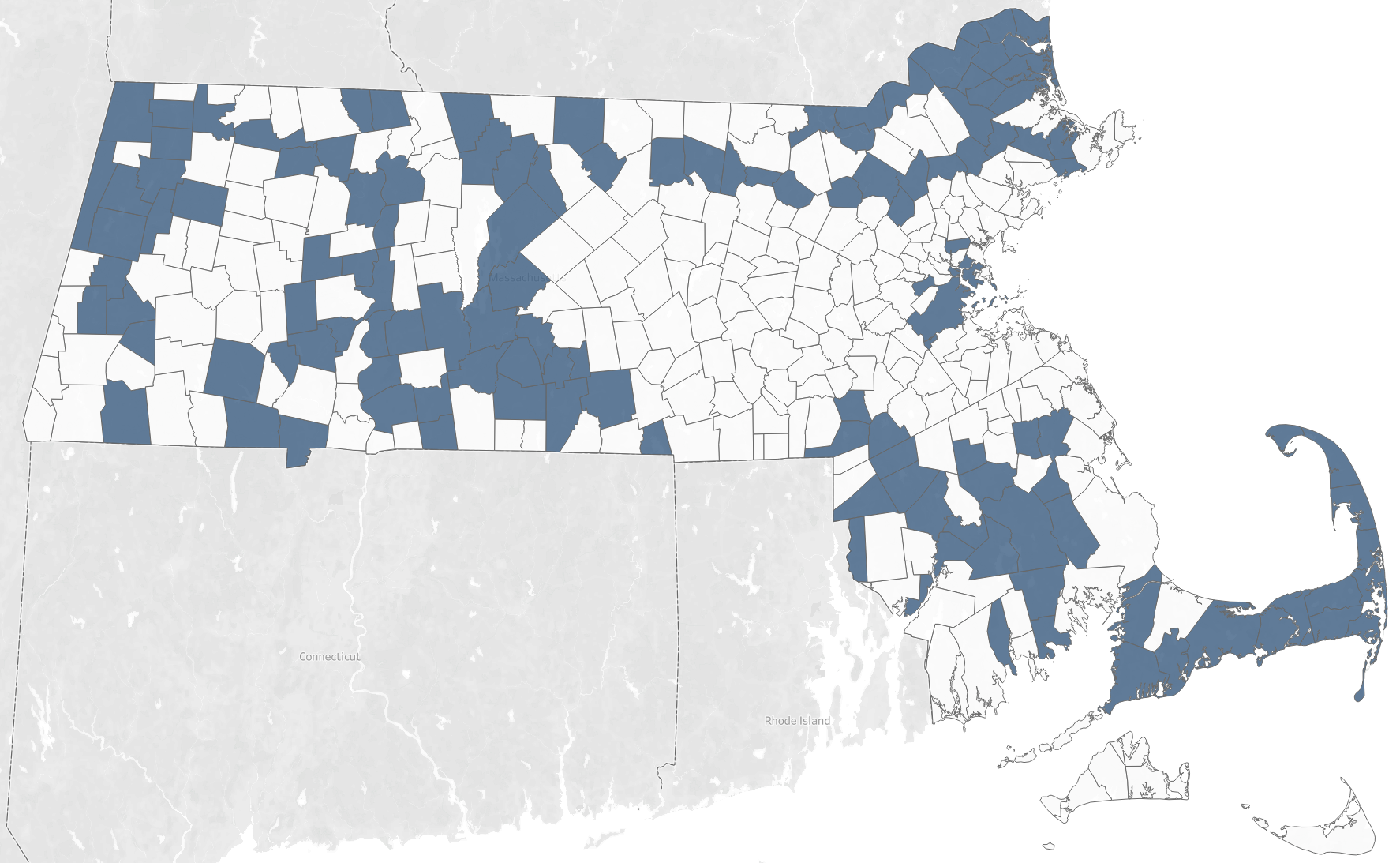
Below are the libraries that rely on E-Rate to provide free internet to library users.
Why is the FCC proposing the change?
FCC Chair Brendan Carr, who helped write the chapter of Project 2025 that calls for cutting broadband funding, released a statement linking E-Rate and the need to reduce screen time for kids.
Senator Ed Markey (D-MA), who created the E-Rate program as part of the Telecommunications Act of 1996, also released a statement calling the FCC Vote “a deeply troubling step toward weakening E-Rate, a universal program that has connected millions of students, teachers, schools, and libraries — in urban and rural communities alike — to the internet for 30 years.”
The E-Rate Program is funded through the federal Universal Service Fund (USF). The USF is supported by contributions from telecommunications carriers that often pass the cost on to consumers.
People rely on Massachusetts Libraries for Internet Access
376,884 Massachusetts households recieved internet assistance from the Affordable Connectivity Program, which Congress ended in 2024. To be eligible, a household must either have had income at or below 135% of the federal poverty guidelines, or participation in programs like SNAP, Medicaid, or Federal Public Housing.
Each week, more than 46,000 people use free internet in Massachusetts public libraries, adding up to more than 2.4 million uses a year. This number is still increasing, up 2% in 2025, and does not include people who use library Wi-Fi on their personal devices.
97.58% of public libraries provide Wi-Fi in the building.
75% (263) of Massachusetts libraries lend hot spots so that residents can access the internet; some Community Colleges do as well.
State and local budgets cannot absorb the deficit if E-Rate is reduced or eliminated.
Municipalities with E-Rate supported public libraries in 2026
Massachusetts Library Telecommunications Funding
The Massachusetts Board of Library Commissioners (MBLC) uses state funding to budget line 7000-9506 to support library internet and telecommunications. Last year the MBLC awarded $540,165 in telecommunications funding that impacted 368 library locations.
The MBLC encourages, but does not require, the library automated resource sharing networks to participate in the E-Rate program. Many of the networks choose to do so on behalf of their members, and their participation brings not just additional funding for their members, but also increases the availability of the limited state funding to others.
The networks and libraries who participated in E-Rate last year received $1,900,963.37 in upgrades and services at a discounted cost to them of only $340,392.97. These savings are passed on to everyone in the Commonwealth through their reduced requests for state and municipal funding.
For example:
| Request Without E-Rate | Request After E-Rate | Final MBLC Grant |
|---|---|---|
| $436,252.07 | $196,466.93 | $166,487.00 |
The MBLC cannot increase the funding to this grant to make up for the $1.5 million (at minimum) deficit that will be created by the FCC’s reduction or elimination of E-Rate. Even libraries and networks not participating in E-Rate would be affected.
The burden to maintain internet in libraries will fall on municipalities already struggling with local budgets.
Other ways Federal Support for digital equity in Massachusetts is being cut
- In May 2025, the Trump Administration terminated 14.1 million in federal funding to expand internet access for veterans, rural communities, and individuals with disabilities in Massachusetts. The previously awarded funding from the Digital Equity Act (DEA) Capacity Grant Program would have provided communities with the tools, skills, and resources to expand the adoption and use of high-speed internet service.
- In September 2025, the FCC voted to end discounts for library Wi-Fi hotspot lending and school bus connectivity programs.
Additional Resources
Helpful instructions and links to federal docket to provide comments is provided by Schools, Health and Libraries Broadband Coalition's (SHLB) Save our E-Rate site.
USAC E-Rate Program
American Library Association (ALA) Resources:
- ALA Save our E-Rate site provides an easy way to contact legislators and sign up for alerts.
- Open Letter from ALA President Maria McCauley (Cambridge Public Library)
- Show Up For E-Rate: A guide to planning a congressional visit at your library.